Communicate

If You Want The Truth Out Of Someone, Send Them A Text Message

A new study shows that people are more likely to tell the truth in text messages than they are in phone calls.


April 26, 2012
Fix

Keeping Secrets Can Make You Physically Weaker

You’ve probably heard that keeping secrets is a burden emotionally, but new research in the Journal of Experimental Psychology suggests it may also be a physical encumbrance. The research suggests that when you’re holding onto a secret, you can’t judge spatial distance and you rate physical tasks as more difficult than they really are.


April 17, 2012
Fix

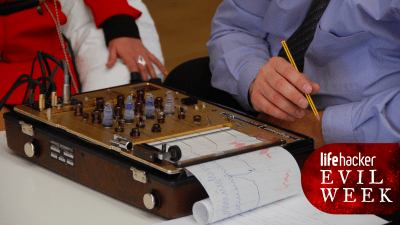
Create A DIY Polygraph Machine With Tin Foil And An Arduino

There’s no foolproof way to prove that your sister actually stole your sunglasses, but polygraphs can sometimes do a pretty good job. Here’s how to throw together a DIY polygraph machine with nothing but an Arduino, some wire and some tin foil.


March 27, 2012
Work

How To Spot The Mike Daisey In Your Own Life

The Mike Daisey/Apple/Foxconn/This American Life fiasco can teach us more than how to properly label your one-man theatre monologues. It gives us a little retroactive wisdom about the common traits of people selling big fabrications, and how they can be found out.


January 20, 2012
Communicate

How To Detect Lying Over The Phone

Have you ever felt like a customer service rep or friend was lying to you over the phone? It’s hard to detect deception without visual cues, but Psychology Today suggests it’s not impossible if you listen closely for for a few specific words.


December 22, 2011
Work

Be Wary Of Doing Business Via Text Messages

Texting is a fast and easy way to communicate, but it has its disadvantages too. A new study by the Sauder School of Business at the University of British Columbia reveals that people may be more likely to lie over text message conversations than when they’re speaking face to face.


October 25, 2011
Communicate

How To Read Body Language To Reveal The Underlying Truth In Almost Any Situation

You’ve likely heard that body language accounts for up to 55 per cent of how we communicate, but reading non-verbal cues isn’t just about broad strokes. The same gesture can indicate a number of different things depending on context. In this post, we’re going to take a look at three common situations in which non-verbal cues are especially important — detecting lies, going on a date and interviewing for a job — then explain how to interpret body language more accurately so that you can read between the lines when a person’s words aren’t necessarily conveying the way that they honestly feel.


October 18, 2011
Communicate

How Science Can Teach You To Easily Spot A Liar

We’ve mentioned a few ways to detect liars, but Pamela Meyer has discovered just about all of them. She’s taken a look at the most common behaviours of liars, scientifically, and shares her expertise on how to detect them.


August 3, 2011
Fix

How To Use Your Dark Side For Good

It would be easier to view the world as black and white, but often things just don’t work that way. Sometimes rules fail you, what’s designed to be good turns out to be bad, and ignoring the evil things in the world makes us anything but safe. Here’s why getting in touch with your dark side can be the right thing to do, and how you can use a little bad for good.


December 11, 2010
Work

Detect Liars By Offering Them Two Choices

Need to weed out a liar? Try tricking them with a choice. Because liars have to think so much to keep track of their lies, they’ll often be unable to come up with an alternate to the options you provide.